Sicily's Golden Cathedral, Eight Kilometres Above Palermo
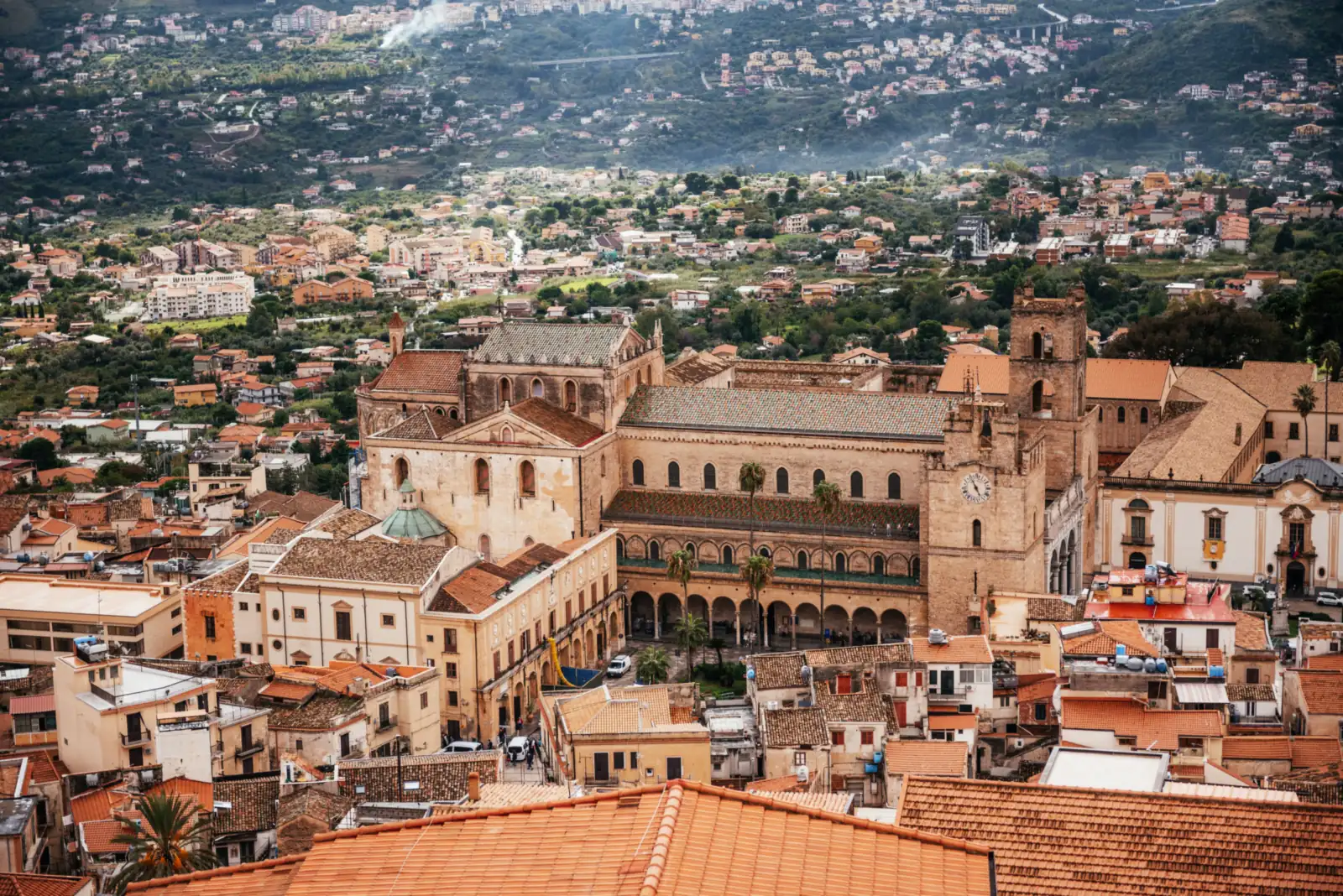
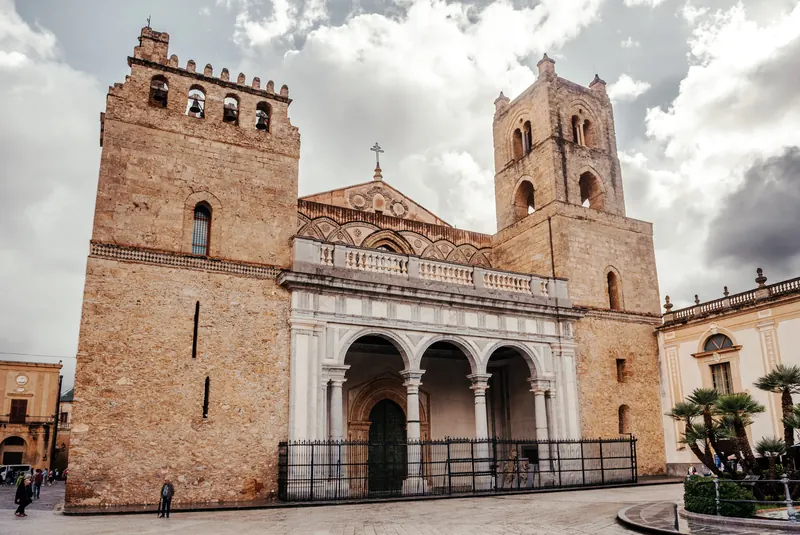
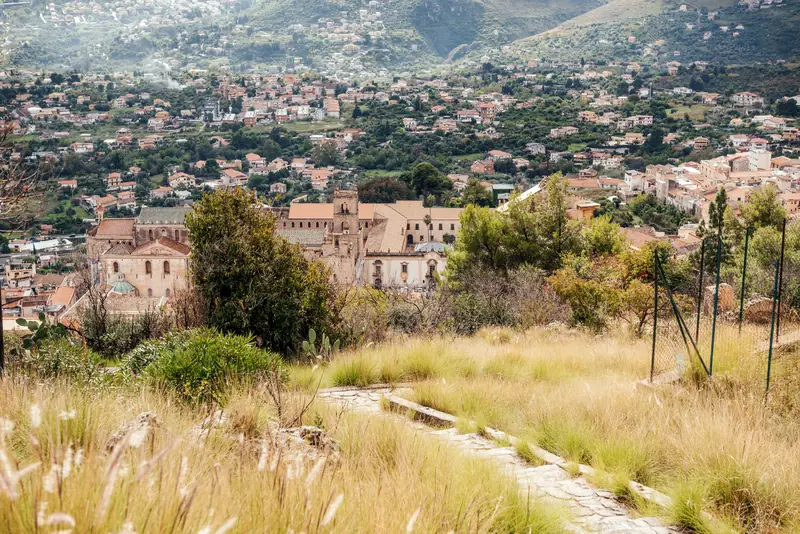
Monreale sits on the slope of Monte Caputo at around 310 metres, roughly 8–10 km above central Palermo, looking down over the citrus valley the Sicilians call the Conca d'Oro — the Golden Shell. From the square outside, the cathedral is handsome but not overwhelming: two blunt Norman towers, a Renaissance portico bolted on in the 16th century, warm honey-coloured stone.
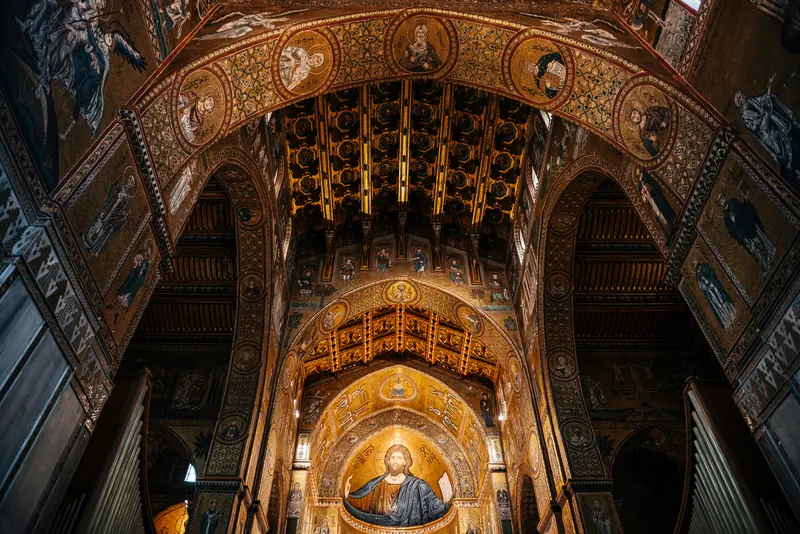
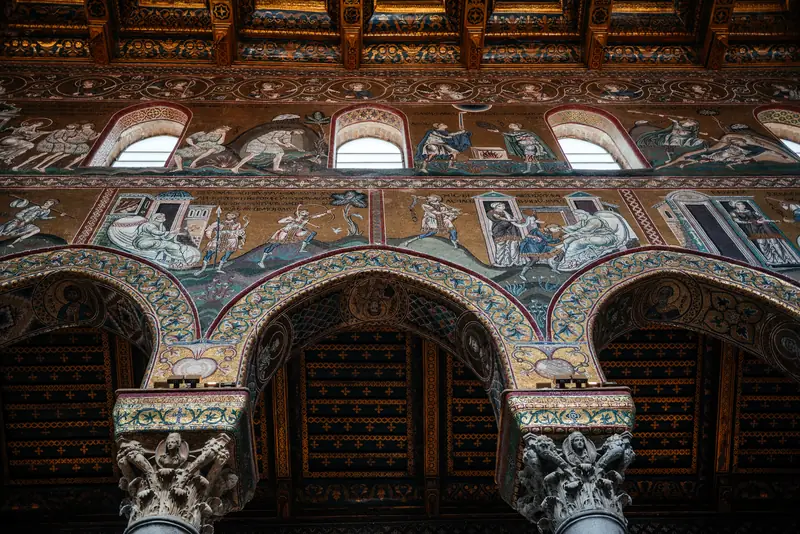
Then you step through the bronze doors and the whole building turns to gold. Mosaic covers the walls, the arches and the apse — around 6,340 m² of gold-ground Byzantine work, more than 130 biblical scenes running from the Creation to the life of Christ, with a colossal Christ Pantocrator filling the half-dome above the altar. It is the most extensive mosaic decoration in Italy, and it was assembled in a single furious campaign that was largely finished by the death of its founder, William II, in 1189.
Visiting is not quite as simple as turning up, though. The church and the cloister are run by two different organisations with two different tickets and two different timetables, and Sunday mornings and religious services regularly close the doors on people who travelled up specially. This guide covers what is worth paying for, how to get here from Palermo — including the hop-on hop-off bus, which is more complicated than it looks — and the specific circumstances where booking a tour genuinely saves you a wasted morning.
Easiest way up if you just want time inside: From $46 — Monreale Self-Guided Tour: Return Van Transfer from Palermo. A return shuttle from central Palermo that drops you at the cathedral and collects you later, so you visit at your own pace with no bus timetable to decode. Check live dates below.
Monreale Cathedral at a glance
| Question | Short answer |
|---|---|
| Why go? | ~6,340 m² of gold mosaic, a 13 m Christ Pantocrator, a 12th-century Benedictine cloister and rooftop views over the Conca d'Oro |
| How far from Palermo? | About 8–10 km; roughly 30–35 min by city bus, 11–15 min by taxi |
| How long do I need? | 30–45 min for the cathedral alone; ~90 min with the cloister; 2–3 hours for everything |
| Is it free? | The nave is normally free. The cloister, terraces, museum and chapels are ticketed — and sold separately from each other |
| Best time? | Weekday morning, close to opening |
| Do I need a tour? | No — but yes if you're on a cruise clock, short of time, driving, or travelling with family |
| UNESCO? | Yes, inscribed 2015 as part of "Arab-Norman Palermo and the Cathedral Churches of Cefalù and Monreale" |
Is Monreale Cathedral worth visiting?
For most first-time visitors to Palermo, yes — and it is worth being clear about why, because "another historic Sicilian cathedral" undersells it badly.
The case for Monreale is scale. The Cappella Palatina down in Palermo is the jewel-box: smaller, more intimate, arguably finer in its detail. Monreale does something different. It overwhelms. Gold mosaic runs across thousands of square metres in two tiers around the nave and up into the apse, and the effect that visitors describe again and again is of walking into an illuminated Bible rather than a building. The historian John Julius Norwich, who thought Monreale lacked the "gemlike perfection" of the Palatine Chapel, still concluded that "its impact, like the cathedral itself, is colossal."
The visit also gets substantially stronger if you treat it as three things rather than one: cathedral, then cloister, then terraces. Plenty of people photograph the Pantocrator and leave within twenty minutes, and they miss the two parts that most often change minds.
Monreale is a weaker use of your time if churches, mosaics and medieval history genuinely don't interest you and your Palermo days are already tight. A small minority of visitors do come away thinking it was just another big church. But if you are picking only a couple of Arab-Norman sites in Sicily, this is one of them.
Worth pairing with a morning at Monreale
Monreale is a half-day, which leaves room for the rest of the region. Most visitors pair it with Palermo's Arab-Norman core — the Cappella Palatina and the Norman Palace — or with a Palermo street-food walk through the Ballarò and Capo markets. Further out, Cefalù on the north coast, the Doric temple at Segesta and the beach at Mondello all combine naturally with a Monreale morning. Browse live options and prices for these Sicily experiences below.
What makes the mosaics extraordinary
The cathedral was begun in 1172 by the Norman king William II, "the Good", and approved by papal bull in 1174. The pious version of the story has William falling asleep under a carob tree while hunting, dreaming of the Virgin, and finding treasure buried in its roots. The likelier version is politics: William was locked in a rivalry with Walter of the Mill, the Anglo-Norman Archbishop of Palermo who was building Palermo Cathedral at the same time. Monreale was a royal counterweight — a new archbishopric, and a dynastic mausoleum for the Hauteville kings.
What that rivalry bought is a building where Byzantine mosaicists, Islamic-influenced craftsmen and Latin sculptors all worked at once, and fast. Look for:
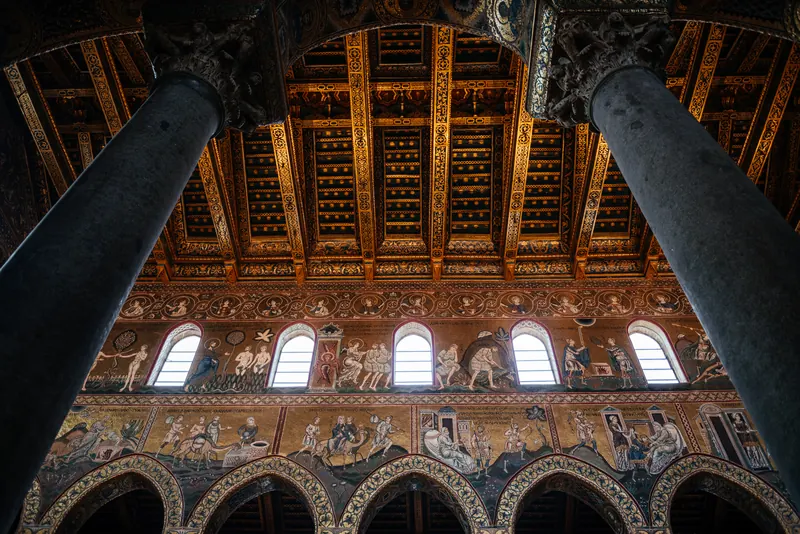
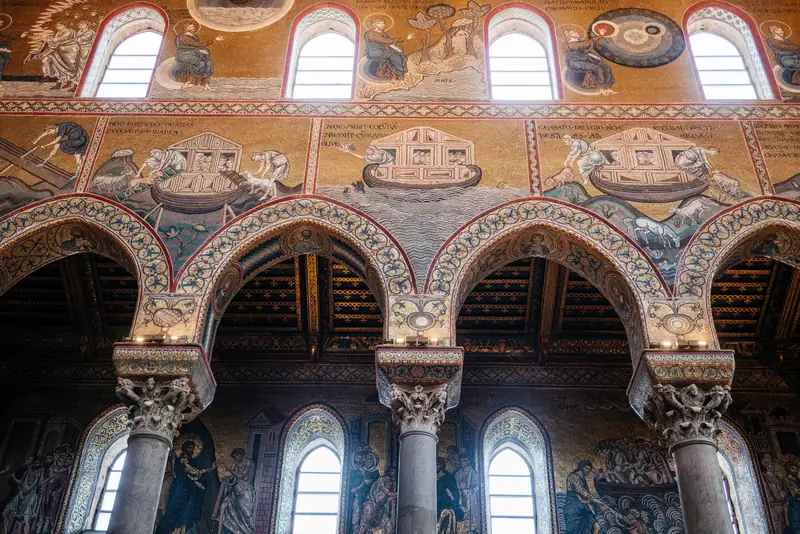
- The Old Testament cycle — Creation through to Jacob wrestling the angel, running in two tiers around the nave. The Noah panels, with the ark riding a mosaic sea, are among the most-photographed.
- The Christ Pantocrator — roughly 13 m wide and 7 m high in the apse, with the enthroned Virgin, archangels, apostles and ranks of saints below.
- Two royal-propaganda panels, unusual in the Western tradition: William II being crowned directly by Christ, and, facing it, William offering a model of the cathedral to the Virgin.
- St Thomas Becket — one of the oldest mosaic depictions anywhere, added within a few years of his canonisation in 1173.
- The painted timber ceilings, with Arab-style muqarnas "stalactite" work over the crossing, restored after the fire of 1811.
The gold itself has been estimated at around 2,200 kg of gold-leaf tesserae, set at slightly varying angles so they catch raking light — which is exactly why the time of day you visit matters more here than at most churches.
Recently relit. A restoration completed in 2024 — the first major work since 1978 — cleaned the mosaics, stabilised loose tesserae and installed a new LED lighting system, at a cost of roughly €1.1 million funded by the EU. A second phase focused on the central nave is planned, so check for scaffolding or partial closures before a special trip.
Don't skip the Benedictine cloister
The cloister is the part people cut when they're running late, and it is the part most likely to be the highlight of the day. It's a square of roughly 47 × 47 metres, 26 arches a side, carried on 228 paired columns (Wikipedia says 216 — nobody agrees, and counting them yourself is a legitimate way to spend twenty minutes).
No two capitals are alike. Biblical scenes sit beside Norman hunting parties, bestiary animals and pure geometric interlace, and because the designs never repeat, the cloister rewards walking it slowly rather than photographing one corner. Look for the famous Samson capital, and the votive capital showing William II offering the church. In the south-west corner a stylised palm-tree fountain served as the monks' lavatorium, where they washed before eating.
It was finished around 1200, and a good many visitors rate it as highly as the church. Crucially, it is not covered by your cathedral ticket — see the ticketing section below.
Are the rooftop terraces worth it?
If stairs and heights are not a problem for you: yes, and it's the easiest upgrade on the site to recommend.
The route climbs more than 100 steps — counts vary depending on where you start — through narrow, dimly lit passages before opening onto rooftop walkways above the cloister, the town and the whole Conca d'Oro spread out toward Palermo and the sea. Handrails and railings are in place, and the verdict in reviews is close to unanimous.
But be honest with yourself about the climb. There is no lift, several stretches are genuinely confined, and anyone with real vertigo, claustrophobia or limited mobility should plan to stay at ground level. The cloister's ground floor is wheelchair accessible, via the entrance from the Villa Comunale; the terraces are not.
Monreale tickets, explained — this is the bit that catches people out
The single most useful thing to understand before you arrive is that Monreale is not one attraction with one ticket. It is two managements sharing a wall.
- The cathedral is run by the diocese. Entry to the main nave is normally free for individual visitors, with a donation welcome and no booking needed.
- The cathedral's "monumental" areas — the Roano Chapel, the terraces, the exhibition rooms and the Diocesan Museum — are diocese-ticketed, commonly quoted at around €6, with a terrace-only ticket often sold for about €2 at the foot of the stairs.
- The Benedictine cloister is a state monument, sold through CoopCulture on its own ticket — around €7 full, €3.50 reduced — with its own opening hours. Under-18s go free; EU citizens aged 18–25 pay the reduced rate.
- Combined tickets exist: roughly €10 for Duomo + Cloister, and around €12–13 for the full Complesso Monumentale covering the Duomo, cloister, Roano Chapel, terraces, exhibition rooms and Diocesan Museum.
The two traps. First: a cloister ticket does not include the cathedral's paid areas, and a cathedral ticket does not include the cloister — which is why two people can both say they bought "a Monreale ticket" and mean completely different things. Second: Italy's state free-entry days (first Sunday of the month, and civic days such as 10 March) apply only to the state-run cloister, not to anything the diocese controls.
If you want the fullest visit, look specifically for an option covering the monumental areas, the cloister and the terraces rather than assuming the first ticket window you reach sells everything. And treat every price above as indicative: they drift, and they are quoted inconsistently even by reputable sources.
Opening hours, Sundays and the closure problem
Hours are the other thing that ruins trips here, and they diverge between the two managements. As currently published:
- Cathedral (diocese): broadly Mon–Sat 09:00–13:00 and 14:00–17:00, with last entry shortly before closing. On Sundays and holidays, morning tourist visits are suspended — afternoons only. No visits during Mass or celebrations.
- Cloister (state / CoopCulture): broadly Mon–Sat 09:00–19:00, Sundays and holidays 09:00–13:30, with last admission 30 minutes before closing.
- Museum, Roano Chapel and terraces: generally shorter windows again, roughly 09:00–13:00 and mid-afternoon.
Check both schedules the day before you go. Otherwise reputable sources publish contradictory hours for Monreale, which is itself the evidence that they change. Weddings, funerals and feast days close the church to tourists at short notice, and Holy Week and Christmas bring major liturgies. The diocese publishes the church hours; CoopCulture publishes the cloister hours. They are not the same page, and they are not always in step.
The practical upshot: Sunday is the worst day to attempt Monreale as a first choice, and a weekday morning is the safest.
How to get from Palermo to Monreale
Four realistic ways up the hill, plus the hop-on hop-off bus, which deserves its own explanation because its Monreale service is not what most people assume they're buying.
1. AMAT city bus 389 — the cheap way
The standard public option is AMAT line 389 from Piazza Indipendenza, behind the Norman Palace and about a kilometre from the centre. The ride takes roughly 30–35 minutes and buses run something like every 35–40 minutes across the day. A 90-minute ticket is around €1.40, or about €3.50 for a day pass — buy at a tobacconist before boarding, because there's a surcharge on board, and validate as you get on.
Coming from Palermo Centrale, take AMAT 109 to Piazza Indipendenza first and change. Two warnings: watch your pockets on a busy 389, and ignore any mapping app that routes you to a stop at the bottom of the hill — that leaves you with a long, steep stair climb. Confirm the current timetable before you commit your morning to it.
2. Taxi — the fast way
Roughly €20–26 each way and about 11–15 minutes. Fares are often fixed for the run, and sharing is normal. For two or more people it's a reasonable trade against the bus, especially on the return when you're tired and the 389 has just gone.
3. Driving — usually the worst way
Corso Calatafimi to the SS186 and SP69 gets you there, but central Monreale is steep, narrow, crowded and covered by a ZTL. Parking in the old centre is scarce to nonexistent. If you do drive, use the paid car parks at the town entrance — around €2 an hour — and walk in. Do not attempt the old-town lanes.
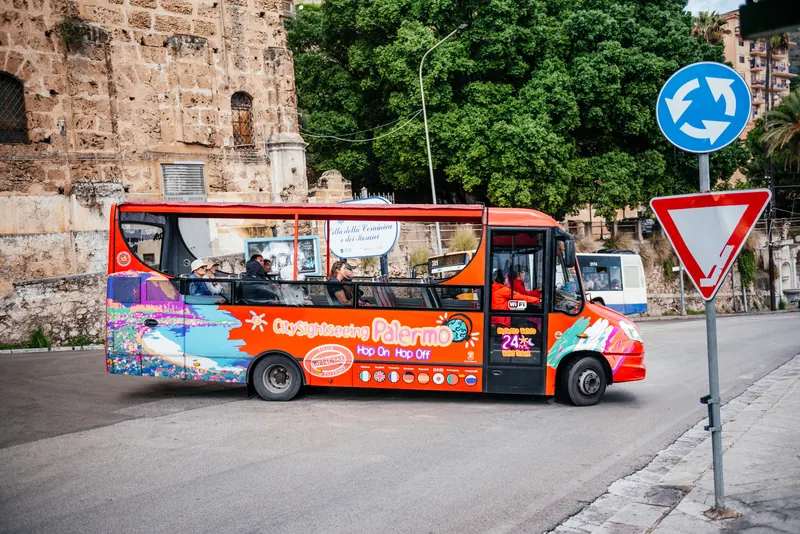
4. The Palermo hop-on hop-off bus — read this before you book
City Sightseeing Palermo's open-top buses are the option most visitors ask about, and the one most often mis-bought. Both city lines leave from the same terminal outside the Teatro Politeama, at Via Emerico Amari 138, and the operator's own description is blunt about the structure: the service "is divided into line A, which allows you to view the splendors of the historic center, and line B, which shows the Art Nouveau area of the city… A further itinerary reaches the Cathedral of Monreale."
That "further itinerary" is the crux. Here are the three routes on offer:
| Route | What it covers | Shape of the ride | Reaches Monreale? |
|---|---|---|---|
| Line A (red) — historic centre | Palermo Cathedral, the Norman Palace, Teatro Massimo, the Quattro Canti and the old core | About a 60-minute loop, buses roughly every 30 minutes — the frequent, reliable one | No |
| Line B — Art Nouveau Palermo | The Liberty-style villas, the Giardino Inglese, the museums and the Zisa Castle quarter | About a 50-minute loop, roughly hourly, so plan around it | No |
| The Monreale line | Climbs out of the city to the cathedral square in Monreale, with the Conca d'Oro opening up on the way | Around a 2-hour round trip, and only a handful of departures a day rather than a rolling loop | Yes — but only as a paid add-on |
Route structure per City Sightseeing Palermo (Sightseeing Experience). Frequencies and departure times are seasonal — check the current timetable before you plan around them.
The thing to get right: the headline "24-hour ticket" price covers the two city routes only. GetYourGuide lists "bus to Monreale and/or Mondello Beach" under what's included "if selected" — and under what's not included "if not selected". One recent reviewer put it plainly: "I had the 48-hour ticket + Mondello. You had to pay an add-on to go to Monreale." Another warned that "the lowest price is misleading" and to check carefully which lines you're actually buying. If Monreale is the reason you're booking, make sure the Monreale option is ticked before you pay.
Our honest take: the hop-on hop-off is a good buy if you want a lazy overview of Palermo and a scenic run up to Monreale bundled into one 24-, 48- or 72-hour ticket, and it's the most comfortable way up on a hot day. It is a poor buy if Monreale is your only goal. With a roughly two-hour round trip and only a few departures, your time at the cathedral is dictated by the return bus, which is precisely the pressure you don't want when the cloister and the terraces need 90 minutes between them. For that, the dedicated shuttle below or the 389 both leave you freer. Note also that the tour rates 3.9 out of 5 across nearly 2,900 reviews — respectable for a city bus, well below the guided Monreale options — with recurring complaints about heat, no air conditioning and patchy on-board audio.
Check Hop-on Hop-off Tickets & Add-ons
5. Shuttle or guided tour — the no-planning way
A return shuttle is the middle path: someone else handles the drive, the ZTL and the parking, but you're still free inside the cathedral for as long as you like. A guided tour adds the interpretation, which matters more at Monreale than at most churches, because a great deal of what you're looking at is a narrative cycle you can't read without help. See the tour options below.
Guided tour vs visiting independently
You do not need a guided tour to enjoy Monreale, and we'd rather say so than pretend otherwise. Here's the honest split:
| Go independently if… | Consider a tour or shuttle if… |
|---|---|
| Your schedule is flexible | You're arriving on a cruise and on the clock |
| You're comfortable using Palermo's buses | You'd rather not decode the 389 timetable |
| You mainly want time with the mosaics | You want the iconography explained as you go |
| You don't mind checking two sets of opening hours | You can't afford a wasted morning on a closure |
| You're travelling cheaply | You're with family, older relatives or a group |
| You'd rather linger in the town afterwards | You're combining Monreale with Cefalù or Segesta in one day |
Best Monreale tours from Palermo
Organised by what you actually need rather than by price. All figures were checked in September 2026; live prices and dates are on GetYourGuide.
Best simple transfer — Monreale return shuttle
Monreale Self-Guided Tour: Return Van Transfer from Palermo — ★ 4.7 across 267 reviews, from about $46. A round-trip van from central Palermo that drops you at the cathedral and picks you up later. No guide, no group to keep up with, no bus timetable. If you want maximum time inside for minimum planning, this is the one.
Best first visit — Monreale with Palermo's other Norman sights
Capuchin Catacombs and Monreale Cathedral Private Tour — ★ 4.7 across 71 reviews, from about $255 for a private tour. Pairs Monreale's mosaics with Palermo's famously unsettling catacombs, guided throughout. Expensive per head unless you're a group of three or four, where it starts to make real sense.
For the cathedral and cloister with a guide plus a stop at a Monreale ceramics workshop, there's also a Private Monreale Cathedral and Cloister, Ceramic Lab tour at ★ 4.8 from about $243 — though on just 11 reviews so far, so treat that rating as promising rather than proven.
Best full-day trip — Monreale and Cefalù together
From Palermo: Monreale and Cefalù Half-Day Trip — ★ 4.3 across 1,637 reviews, from about $70. Comfortably the most-booked way to combine the two, taking the north-coast road to Cefalù after the cathedral. The rating is solid rather than stellar, but the review count tells you it works. If you'd rather go deeper on Cefalù itself, see our day trips from Palermo guide and the Cefalù walking tour.
Prefer ancient Greece to the coast? Monreale & Segesta from Palermo — Small Group pairs the cathedral with the lone Doric temple at Segesta, ★ 4.5 across 62 reviews from about $105.
Compare Monreale & Cefalù Day Trips
Best for cruise passengers
Monreale is roughly 20 minutes from the Palermo cruise terminal, which makes it very doable on a port day — and it's exactly the situation where a booked transfer beats improvising, because a Sunday-morning closure or a missed 389 is unrecoverable when the ship sails at five. Palermo Experience: Monreale, Catacombs and Mondello with food tasting bundles the cathedral with the catacombs, Monte Pellegrino and the beach at Mondello — ★ 4.8 across 96 reviews, from about $99. Note that site entry fees are typically excluded from shore excursions.
Best time to visit
A weekday morning close to opening is the answer, for two independent reasons.
First, light. The gold tesserae are deliberately set at slightly different angles to catch raking light, and morning sun through the clerestory windows is when the interior genuinely glows rather than merely glinting. Second, crowds. Coach groups build from mid-morning through midday and cluster hardest in summer and on cruise-heavy days; arriving at opening is the single most effective crowd-avoidance move available.
Across the year, spring and autumn are ideal — summer is hot, busy and full of buses. One date to know: the town's dominant festival is the Santissimo Crocifisso, held 1–3 May, culminating in the evening procession of the Vara on 3 May. It has run since 1625–26, which makes 2026 its 400th anniversary, with an extended programme through late April. Spectacular if you want it; disruptive if you don't.
How long should you spend at Monreale?
- 30–45 minutes — the cathedral only, walked through at a decent pace.
- About 90 minutes — cathedral plus cloister. This is the sensible minimum, and the one most people should plan for.
- 2–3 hours — cathedral, cloister, terraces and the museum areas without rushing, plus a wander into the town.
That range is what makes Monreale such a good half-day from Palermo: substantial enough to justify the trip, short enough to leave your afternoon intact.
Monreale vs Cappella Palatina vs Cefalù
The three great Arab-Norman interiors get compared constantly, usually badly. The honest version:
| Site | Its real strength | Choose it if… |
|---|---|---|
| Monreale | Overwhelming scale — the largest mosaic cycle in Italy, plus a cloister with no equal in Sicily | You want one interior that stops you in the doorway |
| Cappella Palatina, Palermo | Jewel-box refinement and finer detail in a much smaller space | You care more about craftsmanship than scale, and you're already in Palermo |
| Cefalù Cathedral | An older Pantocrator — 20–30 years earlier — that many find more sublime, in a sterner, smaller church | You're heading to the coast anyway and want the earliest and best-preserved of the three |
A common ranking among informed travellers runs Monreale first, Cappella Palatina second, Cefalù third — but that flattens real differences in taste. If you've already seen Cefalù, Monreale still justifies itself on scale and on the cloister. And Palermo Cathedral, for what it's worth, is the mirror image of Monreale: spectacular outside, largely neo-classical and plain within.
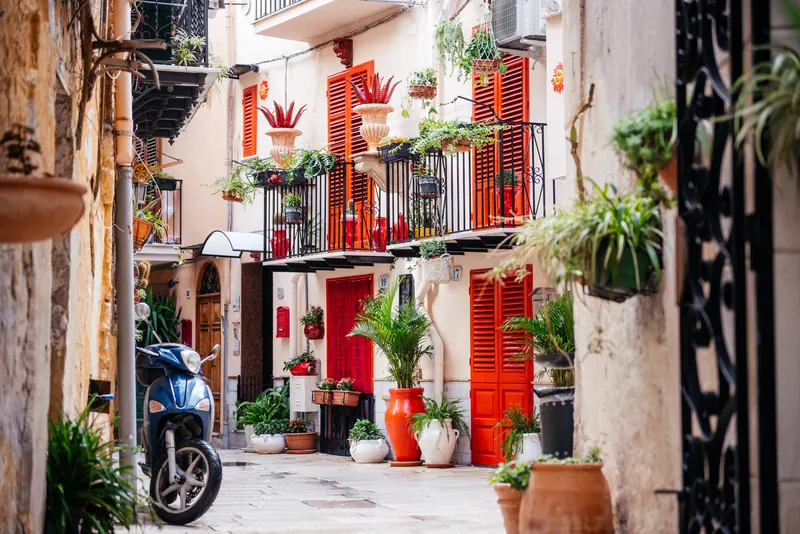
The town of Monreale itself
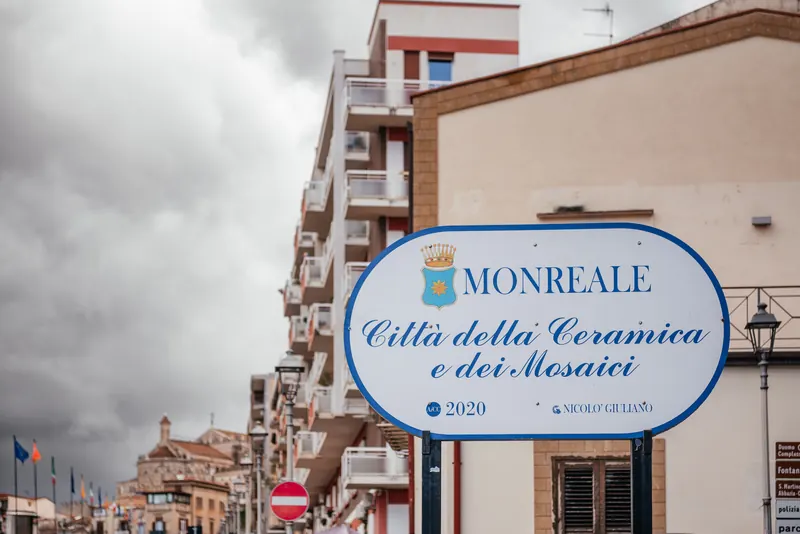
Most people leave straight after the cathedral, which is a small waste. The Belvedere public garden gives a sweeping view over the Conca d'Oro toward Palermo, Monte Pellegrino and the sea. Behind the Duomo, the medieval Ciambra quarter is where the 12th-century workers lived. Piazza Vittorio Emanuele has an 1881 Triton fountain, and the lanes are lined with ceramics — Monreale bills itself as the Città della Ceramica e dei Mosaici.
To eat: look for Monreale biscuits, the dry, S-shaped iced ones invented by the Benedictine nuns. Restaurants cluster above the cathedral and near the car park, several with valley views — though many close on Mondays and some on Sundays, so check before you count on lunch. If you enjoy this sort of thing, our Sicilian wine and food tours guide covers the tastings around Palermo and the Madonie.
Know before you go
- Dress code: this is a working church and it's enforced — shoulders and knees covered. Bring your own cover-up rather than assuming shawls are lent at the door.
- Photography: permitted, but no flash and no tripods as a rule.
- Terraces: 100+ steps, narrow passages, no lift. Not for limited mobility, serious vertigo or claustrophobia.
- Accessibility: the cloister's ground floor is wheelchair accessible via the Villa Comunale entrance. The town's streets are steep and narrow, so a taxi or private drop-off near the piazza is much easier than the bus.
- Ticket touts at the terrace stairs: occasional reports of visitors being overcharged. Know the official price before you hand over cash.
- Sunday: avoid as a first choice — cathedral mornings are closed to tourists, and the cloister runs a shorter day.
- Parking: use the paid car parks at the town entrance, not the old centre. There's a ZTL.
- Crowds: worst from mid-morning to midday, especially in summer and on cruise days.
Practical details on this page were last checked in September 2026. Prices, hours and bus timetables at Monreale change — and the cathedral and cloister publish theirs separately — so confirm both official schedules shortly before you travel.
Frequently asked questions
Is Monreale Cathedral worth visiting?
Yes, especially if you have any interest in mosaics, medieval architecture or Sicily's Arab-Norman heritage. The draw is roughly 6,340 m² of gold-ground mosaic — the most extensive mosaic decoration in Italy — crowned by a Christ Pantocrator around 13 metres wide. The adjoining Benedictine cloister and the rooftop terraces make it a genuine half-day rather than a quick church stop.
Is Monreale Cathedral free?
The main cathedral nave is normally free for individual visitors. The Benedictine cloister, the rooftop terraces, the Diocesan Museum and some chapels all require paid tickets.
Does a Monreale Cathedral ticket include the cloister?
Not necessarily. The cathedral is run by the diocese and the cloister is a state monument sold separately, so a cloister ticket does not cover the cathedral's paid areas and vice versa. Combined tickets exist, but check exactly what yours includes before you buy.
How long do you need at Monreale Cathedral?
Around 30 to 45 minutes for the cathedral alone. Allow roughly 90 minutes for the cathedral plus the cloister, or two to three hours if you also want the terraces, the museum and time in the town without rushing.
How do you get from Palermo to Monreale?
Monreale is about 8 to 10 km above central Palermo. The cheapest option is AMAT city bus 389 from Piazza Indipendenza, roughly 30 to 35 minutes. A taxi runs about €20 to €26 each way. The Palermo hop-on hop-off bus sells a separate Monreale line as a paid add-on, and shuttles or guided tours handle the trip door to door.
Does the Palermo hop-on hop-off bus go to Monreale?
There is a Monreale line, but it is not part of the standard city ticket. City Sightseeing Palermo runs Line A around the historic centre and Line B around the Art Nouveau quarter, and a separate itinerary up to Monreale that must be selected and paid for as an add-on. The Monreale round trip takes roughly two hours and runs only a few times a day, so check the current timetable before you rely on it.
Are the Monreale rooftop terraces worth visiting?
For most visitors who are comfortable with stairs and heights, yes. The climb is more than 100 steps through narrow passages with no lift, and it opens onto rooftop walkways above the cloister, the town and the Conca d'Oro. Skip it if you have limited mobility, serious vertigo or claustrophobia.
Can you visit Monreale Cathedral on a Sunday?
Sunday needs more planning. Tourist access to the cathedral is generally suspended on Sunday mornings for services, with afternoon visits only, while the separately managed cloister keeps shorter Sunday hours of its own. Check both schedules before travelling.
What is the best time of day to visit Monreale Cathedral?
A weekday morning close to opening. Morning light rakes across the gold tesserae and makes the interior glow, and the coach groups tend to build from mid-morning through midday, especially on cruise days.
Is Monreale better than the Cappella Palatina?
They are different experiences. The Cappella Palatina in Palermo is smaller, more intimate and finer in detail. Monreale wins on sheer scale — thousands of square metres of gold mosaic and a colossal Pantocrator. If you are only choosing one Arab-Norman interior, Monreale makes the bigger impression.
Is Monreale worth visiting if I have already seen Cefalù?
Yes. Cefalù's Pantocrator is older and, to many people, more sublime, but its cathedral is far smaller and sterner. Monreale's case rests on the scale of the mosaic cycle and on the Benedictine cloister, which has no equivalent at Cefalù.
Should I book a guided tour of Monreale?
Not everyone needs one. Independent travel by bus 389 is cheap and works well if your schedule is flexible. A tour or shuttle earns its money for cruise passengers on the clock, first-time visitors on a tight Palermo itinerary, families and groups, and anyone who would rather not deal with buses, the ZTL and two sets of opening hours.