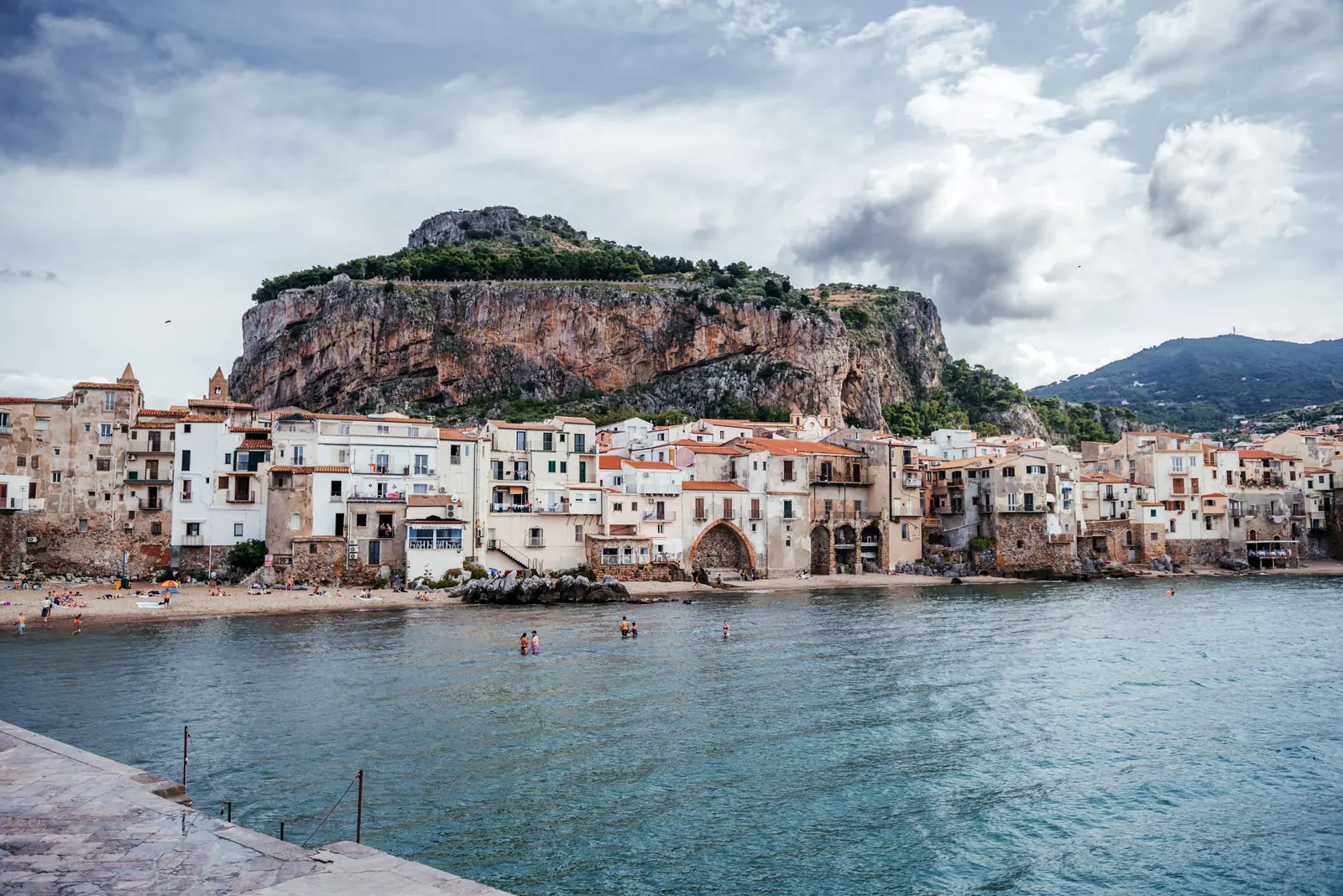
In summer the path has almost no shade and the climb is hard work in the heat. In winter the air is cool, clear days give long views, and you share the trail with very few people. The rock also gave the town its name: the Greek Kephaloidion comes from kephalé, "head", because the promontory looks like one from the sea. Locals call it u castieddu, the castle. On the way up you pass Byzantine and medieval walls, a megalithic building archaeologists still argue about, medieval ovens and cisterns, and at the top the remains of a Norman castle about 270 m above the Tyrrhenian Sea.
This guide is part of our Cefalù in winter (November–February) series. Hours and prices can change by council decision, so check the Comune di Cefalù page or ask at the tourist office before you go.
Key facts: La Rocca in winter
Plan on about two hours for the round trip, and arrive well before the 3 p.m. last entry. Wear closed shoes with grippy soles, because the staff turn away sandals and smooth soles, and pick a dry day.
- What it is: a limestone headland, now an archaeological and nature park (Parco della Rocca)
- Height: 268 to 270 m above sea level (the Comune gives 270 m; plenty of sources use 268 m)
- Entrance: Piazza Garibaldi and Salita Saraceni, where Corso Ruggero ends in the old town
- Winter hours 2026/27: every day 8 a.m. to 5 p.m., last entry 3 p.m., from the switch to standard time
- Tickets: €5 full; €2.50 reduced (ages 6 to 14, over-65s, teachers); residents free
- Round trip: roughly 3.4 to 3.8 km and 220 to 240 m of climbing from the old town; about two hours
- Difficulty: easy to moderate: stone steps first, then a rough rocky path; no wheelchair access
- Footwear: closed shoes with grippy soles are required; sandals, flip-flops and smooth soles aren't allowed
- Water and food: no fountains on the route, so bring your own; picnic tables near the Temple of Diana
- Closures: mayoral ordinances close the park during weather alerts, as on January 19 and 20, 2026
La Rocca itself has no bookable entry: you pay at the gate. If you'd like a guide for the old town below it, the Cefalù: Guided Walking Tour & Authentic Sicilian Aperitivo spends about two and a half hours in the lanes, the cathedral square and the medieval wash-house, then finishes with a Sicilian aperitivo. It doesn't climb the rock, and it pairs well with a morning on La Rocca. It is rated 4.6 from 102 reviews and started from $66 per person when we checked.
When is La Rocca open in winter 2026–27?
The Comune di Cefalù's official Rocca page, last updated on September 28, 2026, sets out a seasonal timetable:
| Period | Open | Last entry |
|---|---|---|
| Winter (standard time: October 25, 2026, to March 27, 2027) | 8 a.m. to 5 p.m. | 3 p.m. |
| Spring (from the clocks going forward; in 2026 this began on Monday, March 30) | 8 a.m. to 7 p.m. | 5 p.m. |
| Summer (summer-time season) | 8 a.m. to 8 p.m. | 6 p.m. |
| From mid-September | 8 a.m. to 7 p.m. | 5 p.m. |
What it means for planning: if you go in at 3 p.m., you have two hours before the park closes at 5 p.m., which is about what the round trip takes. That leaves little time for the Temple of Diana and the views, so start around midday if you want plenty of time.
The staff do apply the 3 p.m. cutoff. One visitor posted on Tripadvisor in April 2026 that they were turned away for arriving after 3 p.m., and that the only warning was a handwritten sign at the entrance.
Online hours don't agree. Many blogs and listing sites still show old timetables. Some give 9 a.m. to 4 p.m. for November to March (theworldofsicily, sicilyintravel, aspassoperlasicilia); an older Tripadvisor answer gives last entry at 3:30 p.m.; AllTrails says no visits after 4 p.m.; and Tripadvisor's listing widget shows 8 a.m. to 6 p.m. The town has changed the hours several times: in February 2023, for example, Cefalùnews published a notice of 8 a.m. to 6 p.m. with last entry at 4:30 p.m. Go by the Comune page and, if you can, confirm at the tourist office on Corso Ruggero.
Is La Rocca open on Christmas Day and New Year's Day?
Unconfirmed. The Comune page lists no holiday closures and doesn't mention December 25 or January 1, and we haven't found an official notice either way. The cathedral's paid itineraries are a separate attraction, and in past years they closed on December 25 and opened only in the afternoon on January 1; don't assume La Rocca does the same. If you want to climb on a holiday, call the park information line on 800 208 129 (VisitCefalù lists this number) or ask at the tourist office first.
Does La Rocca close for bad weather?
Yes, and in winter this is the most important thing to know. When the regional Protezione Civile issues an allerta meteo (weather alert), the mayor can order the Parco della Rocca closed, along with schools, parks and the cemetery. Two recent closures:
- January 19 and 20, 2026: Ordinanza Sindacale n. 1 del 18-01-2026, signed by Deputy Mayor Rosario Lapunzina standing in for the mayor, closed schools, the Parco della Rocca, the cemetery, the villetta and the sports facilities. Il Cefalino reported that the main concern was strong gusts of wind.
- January 17, 2025: during a yellow and orange alert, Mayor Daniele Tumminello closed every school and the Parco della Rocca.
How to check: the evening before, look at the Comune di Cefalù's official Facebook page and the Novità (news) section of comune.cefalu.pa.it, where ordinances usually go up the day before, and at the regional Protezione Civile alert bulletin. Even without an ordinance, don't go up straight after heavy rain. Nobody will stop you, but the path will be in poor condition.
How much are La Rocca tickets, and how do you pay?
| Ticket | Price | Who it's for |
|---|---|---|
| Full (intero) | €5 | Adults |
| Reduced (ridotto) | €2.50 | Children 6 to 14, over-65s, teachers (docenti) |
| Free | €0 | Cefalù residents. Many sources say under-6s are free too, but the Comune page doesn't confirm it |
- Combined tickets: none at the moment. A joint Visit Cefalù ticket was announced in 2021, but in 2026 we couldn't find a working combination with the Duomo or Museo Mandralisca.
- Where to buy: only at the entrance. You can't book online, and you don't need to.
- Payment: carry exact cash and a card. Visitor reports disagree. A reviewer in June 2026 said the booth took both cash and credit cards. In October 2026 a visitor described two machines: at the lower one staff took cards, and a few meters higher a second machine took cash only and was staffed by a Polizia Locale officer. Older reports say exact change only, with no change given.
- Keep your ticket. It is checked again further up, and you may need it to leave.
- Out-of-date prices: sources from before 2023 give €4. The official price is now €5.
Where is the La Rocca entrance, and how do you get there?
The official address is Piazza Garibaldi / Salita Saraceni. From Corso Ruggero, the main street, turn up the narrow Vicolo or Salita dei Saraceni close to Piazza Garibaldi, or take Via Giuseppe Fiore from Piazza Garibaldi. Follow the La Rocca signs up the stepped lanes to the gate and ticket booth.
- On foot from the train station: about 10 to 15 minutes to the gate.
- Driving: the entrance has no parking. An October 2026 visitor said trying to park close by was hopeless; they left the car on the seafront for about €2 an hour and walked up through the old town in about 10 minutes. Parking is much easier in winter than in summer.
- Upper entrance: a few tour listings and older reviews mention a way in from Via Pitrè in the upper town, with fewer steps. We can't confirm it is staffed in winter, so plan on Salita Saraceni.
The route: how long does it take, and how hard is it?
It is short, but it is a proper hike. Fit walkers reach the castle from the gate in 25 to 45 minutes; with photo stops, most people take around an hour to go up and 30 to 45 minutes to come down, so allow about two hours in all.
Distance and elevation: the sources vary a little
| Source | Route type | Distance | Elevation gain | Time |
|---|---|---|---|---|
| AllTrails | Out and back | 3.4 km (2.1 mi) | 238 m (780 ft) | 1.5 to 2 hours |
| Komoot | Loop from town | 3.63 km | 230 m | 1 hour 20 minutes |
| Italia in Cammino | Loop from the old town (37 m to 268 m) | 3.7 km | 219 m | 1 hour 45 minutes |
| Madonie Explorers (guided) | La Rocca and the old town | About 4 km | 270 m | 3 hours including the old town |
The figures we plan with: about 3.5 km and 230 m of climbing for the round trip from the old town. The part inside the park is shorter; one reviewer measured roughly 900 m from the gate to the top.
Surface: AllTrails estimates the route at about 34% rock, 24% paved, 21% natural path and 17% steps. On the ground it splits into two halves:
- Lower half (gate, walls, Temple of Diana plateau): broad, even stone steps zigzag up between the walls and low Mediterranean scrub such as euphorbia and lentisk. There are benches on the way and no drop-offs to worry about.
- Upper half (plateau to castle): the steps run out and the path crosses uneven limestone outcrops. In a few places you'll want a hand on the rock. Years of boots have polished the stone smooth, so it is slippery when wet and sometimes even when dry.
Stop by stop: what you pass on the way up
| Stop | Approx. elevation | Time from gate | What to look for |
|---|---|---|---|
| 1. Old town to the gate (Salita Saraceni) | About 30 to 70 m | 5 to 10 minutes from Corso Ruggero | Stepped lanes and the ticket booth; read the posted closing time |
| 2. Medieval walled path and gateway | 100 to 135 m | 10 to 15 minutes | Three building phases: early medieval, Norman (Roger II) and 16th century (works dated 1553–54) |
| 3. Cisterna Grande | 130 to 135 m | 15 to 20 minutes | The largest cistern in the water system |
| 4. Crenellated walls and cross viewpoint | About 150 m | 20 to 30 minutes | The well-known shot of the rooftops and the Duomo |
| 5. Temple of Diana plateau: ovens, storerooms, Church of Sant'Anna | 150 m | 35 to 45 minutes | The megalithic temple, medieval ovens (forni) and picnic tables under pines and carobs |
| 6. Watch posts (casermette) | About 200 m | 45 to 55 minutes | Signal stations that passed messages along the coast |
| 7. Norman castle ruins (summit) | 268 to 270 m | 55 to 70 minutes | Cisterns cut into the rock, partly collapsed vaulted rooms, views all round |
Do the summit first. Several reviewers suggest heading straight for the top and seeing the Temple of Diana on the way down. You tackle the hardest section, the one weather affects most, while your legs are fresh, and you finish at the shaded picnic spot.
Who can do it?
- Most reasonably fit adults, and children from about 7: yes. Under-18s must be with an adult; that's a park rule.
- Older visitors: usually fine as far as the Temple of Diana plateau; the section above needs care. Reviewers in their late 50s and 60s say it is manageable taken steadily. If balance is a worry, the walls and plateau already give you most of the view, and quite a few visitors think the mid-level views match or beat the summit's.
- Wheelchairs and strollers: no. The whole route is steps and rough rock.
- Dogs: unclear. The official rules don't mention dogs; AllTrails says leashed dogs are welcome, while an Italian hiking site says pets aren't allowed in the park. Phone 800 208 129 before you bring one.
Is La Rocca safe in winter? Weather, slips and rescues
Take the polished rock slowly on the way down, with both hands free: most falls on La Rocca are slips, and most happen on the descent. In dry weather it is safe for walkers who come prepared, but accidents do still happen.
- October 13, 2025: a 75-year-old German tourist hit her head in a fall while on a group excursion. A Soccorso Alpino e Speleologico Siciliano (CNSAS) team and an Italian Air Force HH-139B helicopter from the 82nd SAR Center winched her off the rock, MadoniePress reported. MeteoWeb ran an almost identical report on November 3, 2025; we can't tell whether that was a second accident or the same one reported again.
- April 20, 2025: at around 3 p.m. a 57-year-old man slipped into a gully on the path to the Temple of Diana, and the fire brigade airlifted him out with a head injury (PalermoToday).
- Undated: CNSAS has also reported rescuing an English tourist who hurt her leg slipping on the slick path down from the summit.
In an emergency call 112; the operator passes mountain and rough-terrain calls to 118 and the Soccorso Alpino.
What's the weather like from November to February?
| Month | Average temperature | Rainfall | Rainy days | Approx. sunset |
|---|---|---|---|---|
| November | About 14 to 15°C | 68 mm | 8 | About 4:50 to 5:10 p.m. |
| December | About 11°C | 83 mm | 9 | About 4:40 to 4:55 p.m. |
| January | 9.5°C (lows about 7, highs about 12) | 80 mm | 8 | About 4:55 to 5:25 p.m. |
| February | About 10°C | 77 mm | 8 | About 5:25 to 5:55 p.m. |
Winter here is mild but windy and showery, so expect about one day in four to be wet. Average winds run at 15 to 20 km/h, and storms bring much stronger levante and scirocco gusts. Nothing shelters the summit, so it can feel 4 to 5°C colder at the top than on the seafront.
Can you watch the sunset from La Rocca in winter?
Not from the summit. The park closes at 5 p.m., and in December and January that is roughly when the sun goes down. Go in between 1 and 2:30 p.m. instead, when the low afternoon sun warms the Duomo and the rooftops, and be back at the gate by 4:45 p.m. For the sunset itself, head down to the old harbor or the Bastione di Capo Marchiafava.
What should you wear and bring for La Rocca in winter?
- Closed shoes with grippy soles. Low hiking shoes or trail runners are best. This is a rule: smooth soles, sandals and flip-flops get sent back.
- A windproof layer and a warm mid-layer. Nothing shelters you at the top.
- Water, about 0.5 to 1 liter per person. There are no fountains on the way.
- A snack or picnic for the tables by the Temple of Diana; take all your rubbish away.
- Exact €5 in coins or notes, and a card as well.
- Your phone with an offline map (a Komoot, AllTrails or Wikiloc track) and enough battery for photos.
- Sunglasses. Low winter sun off the sea is surprisingly bright.
- Light gloves if it's windy; on the upper section you'll be holding cold rock.
- Optional: a trekking pole for the way down if your knees need help.
Official park rules: no open or smooth-soled footwear; minors can't go in alone; no fires, camping or bivouacking; don't damage signs; stay on the marked paths; don't climb on monuments or walls or lean out over the edge at viewpoints; and leave no litter, even if it is biodegradable.
Facilities: a visitor mentioned toilets in April 2026, and the 2021 refurbishment added a wooden ticket and welcome building at the entrance. Still, don't count on toilets or a café in winter; use one in town before you set off.
What is the Temple of Diana, really?
No one can say for certain. The name was given in the 18th century, and no inscription supports it. The structure is a megalithic building of huge polygonal blocks, built around a much older rock-cut cistern. Most scholars see it as a sanctuary linked to a water cult and reused over many centuries. Gori and Orlando (2016) go further: they read the building as an entrance hall to the protohistoric cistern and argue it was a genuine solar temple.
Where the sources agree:
- The cistern is the oldest part. It is cut into the rock and roofed like a dolmen, with big limestone slabs resting on a central pillar of stacked blocks. The usual date is around the 9th century BC.
- The building you see came later. The Byzantines eventually turned it into a church. The Comune sums up the sequence as a 9th-century BC cistern followed by Greek, Roman and finally Byzantine alterations.
The dating conflict, laid out simply:
- Cistern: 9th century BC according to the Comune, VisitCefalù and Aspassoperlasicilia; Lonely Planet says 8th or 9th century BC.
- Main megalithic building: 5th century BC according to VisitCefalù and Aspassoperlasicilia; late 5th to early 4th century BC according to other local sources; 4th or 5th century BC according to Lonely Planet; and 6th to 5th century BC according to Gori and Orlando's peer-reviewed 2016 paper in Mediterranean Archaeology and Archaeometry.
- Upper courses above the lintel: 2nd century BC, in better-squared stones (VisitCefalù, Sicilia Fotografica). One 2026 source dates the smaller-block additions to the 13th century instead.
- Italian Wikipedia puts the whole structure in the 9th century BC, which mixes up the cistern and the building.
How we describe it: a megalithic building of the 5th to 4th century BC, built around a protohistoric cistern from about the 9th century BC.
The sun-temple theory: in 2016 Davide Gori and Andrea Orlando of the Institute of Sicilian Archaeoastronomy published a paper in Mediterranean Archaeology and Archaeometry (vol. 16, no. 4, pp. 207–211). They measured the entrance as facing due west, at an azimuth of about 270°, in line with the point where the sun sets at the equinoxes; around the spring and autumn equinoxes the setting sun shines straight down the corridor toward the cistern. With the park closing at 5 p.m. you won't see this in winter, but it is a good story to tell at the doorway.
Who excavated it: the first official excavations were directed by the archaeologist Pirro Marconi, who published the results in 1929 in Notizie degli Scavi under the title Il cosiddetto «Tempio di Diana».
La Rocca's history in two minutes
- From prehistory to the Greeks: the megalithic walls around the plateau date from somewhere between the 9th and 5th centuries BC and belonged to an indigenous settlement that kept watch over the sea. The town's name changed with each power: Kephaloidion to the Greeks, Kefa in Punic sources, Cephaledium to the Romans and Gafludi to the Arabs.
- Byzantine period: after the fall of the Western Roman Empire, people moved up onto the rock because it was easier to defend. The storerooms, ovens and the Church of Sant'Anna at 150 m come from this hilltop town and the medieval settlements that followed.
- Arabs and Normans: under the Arabs the rock became a permanent military position. Roger II brought the town back down to the coast; in 1131 he began the Duomo, now part of the UNESCO Arab-Norman itinerary, and walls that ran for more than 2 km.
- The castle (12th to 13th century): its defenses were strengthened over time. A 1238 document records Frederick II taking the castle from the bishop, which made it one of the most important strongholds in Sicily.
- Watch posts at 200 m: these sent optical signals between stretches of coast that had no line of sight to each other.
- The myth: legend says the rock is the body of Daphnis, a shepherd and son of Hermes. A nymph blinded him for breaking his promise to her, he leapt from a cliff, and Hermes turned him into stone.
The Vecchia Strina: the winter witch who lives on the rock
Local folklore says La Rocca is home to 'a Vecchia Strina, an old woman who brings gifts, rather like a Sicilian Befana. On New Year's Eve she comes down from the castle with her husband, clattering tin cans as she goes; good children get sweets, and naughty ones get ashes or coal. In the days before, from December 28 to 30, older children go round the streets banging rinali, old cans and broken pots, and younger children are warned in dialect that the old woman in the castle is watching them. Her name is usually traced to the Latin strena, a gift given for luck. Our Christmas in Cefalù 2026 guide covers how the town celebrates.
What can you see from the top of La Rocca?
When the winter air is clear:
- West: the coastline runs as far as Capo Zafferano.
- East: beyond Sant'Ambrogio toward Capo d'Orlando.
- North: the Aeolian Islands, with Alicudi and Filicudi faint on the horizon.
- Below you: the patchwork of terracotta roofs, the apse and twin towers of the Duomo, the old fishing harbor, and the beach curving away to the west.
- Inland: the ridges of the Madonie, which sometimes carry a dusting of snow in January and February; see the Madonie in winter.
Photo tip: for the classic rooftop picture, use the cross viewpoint and the crenellated walls at about 150 m; for the widest view of the coast, go to the summit. The air is usually clearest on winter mornings after a north wind, which give you the best chance of picking out the Aeolians.
Should you take a guided tour of La Rocca?
Most people can manage without a guide. The path is well signed, and reviewers say the monuments have information boards in Italian and English. A guide earns the fee if you want the archaeology explained, if your group has mixed fitness levels (a guide can stop at the plateau with anyone who has had enough), or if you want photography tips.
| Tour | Type | Duration | From | La Rocca ticket included? | Rating | Best for |
|---|---|---|---|---|---|---|
| Cefalú: La Rocca Archaeological Park Hiking Private Tour (GetYourGuide; run by Italygonia Travel T.O.) | Private, licensed guide, Italian or English | 2 hours | About $349 to $355 per group (up to 25); about $394 on Viator | No (€5 per person extra) | 5.0 from only 6 reviews | Families or groups who can split one price |
| Cefalù Rocca Guided Hike with Photography Tips & Picnic (GetYourGuide) | Guided hike with photo coaching | 3 hours | About $87 to $115 per person | Not stated | New, no reviews yet | Photographers |
| Urban Trek to the Cefalù Castle (GetYourGuide) | Old town and La Rocca trek | 4 hours | About $208 to $217 per person | Not stated | New, no reviews yet | Hard to recommend at this price unless the itinerary appeals |
| Active Cefalù Tour: Rocca & Old Town (Madonie Explorers, book direct) | Private hike plus an old-town walk | 3 hours, about 4 km, 270 m | €65 per person | Yes, plus coffee and local biscuits | Not rated | Our pick for value; the operator runs it all year |
The La Rocca Archaeological Park Hiking Private Tour has only six reviews so far, so read the recent ones before you book. Madonie Explorers says its tour operates all year; for the GetYourGuide tours, check the live calendar for your dates. Free cancellation is the norm, so you can book and cancel if the forecast turns bad. Prices move with exchange rates. For a guide in the old town instead, the Cefalù: Guided Walking Tour & Authentic Sicilian Aperitivo covers the lanes below the rock; our Cefalù walking tour guide compares the options.
How to pair La Rocca with the rest of Cefalù in winter
Our ideal winter half day:
- 9:30 a.m.: coffee and a pastry near Piazza Garibaldi.
- 10 a.m. to 12:15 p.m.: climb La Rocca. Go to the summit first, stop at the Temple of Diana on the way down, and have a snack at the picnic tables.
- 12:30 p.m.: walk down to the Duomo for the gold mosaic of Christ Pantocrator. The paid itineraries to the towers and roofs may be closed in winter.
- 1:30 p.m.: a long Sicilian lunch in the old town.
- 3 p.m.: see the medieval Lavatoio (wash-house) on Via Vittorio Emanuele, then walk to the Bastione di Capo Marchiafava and the old harbor for sunset at around 4:45 to 5:15 p.m.
If it's raining: go to the Museo Mandralisca, the Duomo and Osterio Magno instead; our rainy-day guide to Cefalù has their winter hours, cooking classes and wet-day plans.
Bigger days out: Palermo and Monreale from Cefalù · Mount Etna from Cefalù in winter · the Madonie in winter
FAQ: climbing La Rocca in winter
How long does it take to climb La Rocca di Cefalù?
Allow about two hours for the round trip. It is about 40 minutes from the gate to the Temple of Diana plateau and another 20 to 25 minutes to the castle, then 30 to 45 minutes back down.
What are La Rocca's winter opening hours?
Every day from 8 a.m. to 5 p.m., with last entry at 3 p.m., from the switch to standard time on October 25, 2026, until summer time returns on March 28, 2027, according to the Comune di Cefalù page updated on September 28, 2026.
How much does it cost to climb La Rocca?
Adults pay €5. Ages 6 to 14, over-65s and teachers pay €2.50. Cefalù residents go free.
Can I pay by card?
Usually, but not necessarily at every machine. Bring exact cash just in case.
Is La Rocca open when it rains?
It may be, unless a weather-alert ordinance has closed it. Even so, we strongly advise against climbing in the rain or soon after, because the polished limestone gets very slippery.
Is the climb hard?
It is easy to moderate. You climb about 230 m, first on steps and then on rough rock. Most fit adults and children can do it, but it is not accessible for wheelchairs or strollers.
Is the Temple of Diana really a temple to Diana?
There is no evidence that it was; the name dates from the 18th century. It is a megalithic building of the 5th to 4th century BC around a cistern from about the 9th century BC, probably connected with a water cult, and later turned into a Byzantine church.
Can I see the sunset from La Rocca in winter?
Not from the summit, because the park closes at 5 p.m., which is about when the sun sets. Enjoy the afternoon light up top, then watch the sunset from the old harbor.
Do I need a guide?
No, the route is signposted. A guide gives you the background and can adapt the walk to your group.
Is La Rocca open on December 25 and January 1?
There is no official confirmation either way. Call the park information line on 800 208 129 or ask at the tourist office.
More from our Cefalù in winter series
- Cefalù in winter (November–February): weather, opening hours, tours and getting there
- Palermo and Monreale from Cefalù: train or tour, hours, tickets and a rain plan
- Christmas in Cefalù 2026: Magico Natale, the nativity trail, New Year and Epiphany
- Rainy day in Cefalù: indoor sights, cooking classes and wet-day plans
- Best time to visit Cefalù, with La Rocca's hours through the rest of the year
Sources and methodology
Last checked October 31, 2026. Hours, prices, rules and elevations: the Comune di Cefalù's Rocca page (updated September 28, 2026), with older timetables from theworldofsicily, sicilyintravel, aspassoperlasicilia, AllTrails, Tripadvisor and Cefalùnews (February 2023). Closures: the Comune di Cefalù notice and ordinance of January 18, 2026, Il Cefalino, PalermoToday, HimeraLive and MadoniePress (January 2025). Payment, parking and facilities: Tripadvisor visitor reviews from April, June and October 2026. Route: AllTrails, Komoot, Italia in Cammino and Madonie Explorers. The two-hour round trip is our planning figure, consistent with the guides' 1.5 to 2.5 hours with stops.
Safety: MadoniePress (October 13, 2025), MeteoWeb (November 3, 2025), StrettoWeb, PalermoToday (April 2025) and CastelbuonoLive. Weather: Climate-data.org, Weather2Travel, Weather-Atlas and Juzaphoto. Temple of Diana and history: the Comune, VisitCefalù, Aspassoperlasicilia, Sicilia Fotografica, Lonely Planet, Italian Wikipedia, Gori and Orlando (2016) and Marconi (1929). Vecchia Strina: Enjoy Sicilia, SiciliaFan and VisitCefalù. Tours: GetYourGuide and Viator listings and Madonie Explorers' own page, October 2026. cefalutours.com earns a commission if you book through our links, at no extra cost to you.